


We are an international family of three: a software engineer in the semi-conductor industry, a sustainability consultant, and an art and animal lover. Sustainability and reducing our carbon footprint matter a lot to us, and that’s shaped how we’ve approached improving our home.
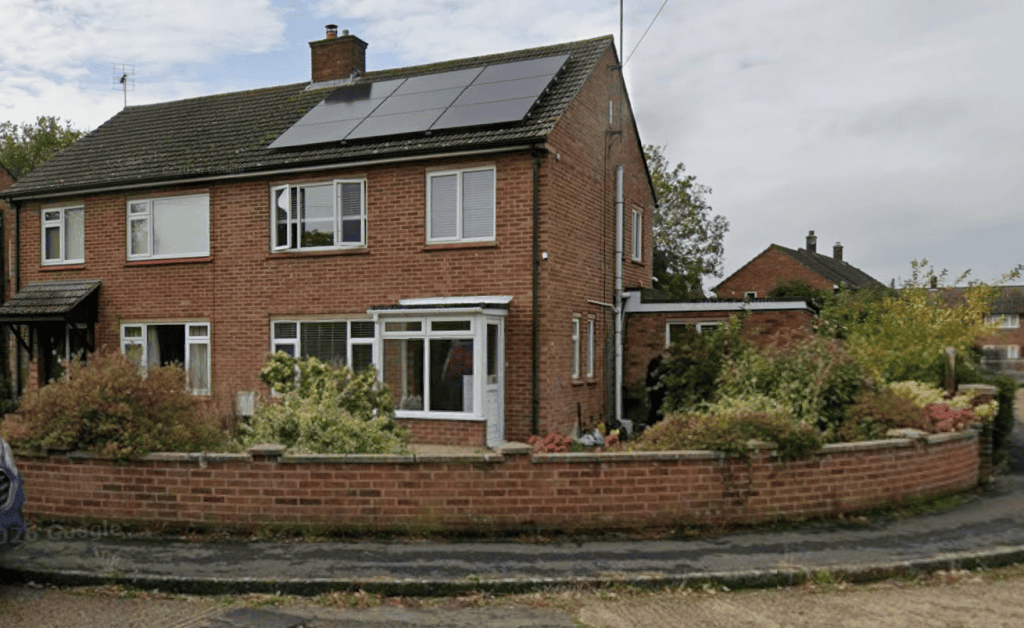
Our goals:
Reduce our carbon footprint and save money.
We were already planning to install solar PV while we were renting, so we did that as soon as we moved into our own property. The heat pump was initially a more long term idea, mostly due to the upfront cost. However, after receiving a quote much cheaper than expected, and considering that the gas boiler was already 12 years old, we decided to go ahead just one year after moving in. Thus, we could simultaneously reduce our carbon footprint and invest in our home.
We’ve installed
We decided not to install a battery since we estimated its ROI to be too low given the current export tariff rates and our patterns of consumption, where we can shift most of our heavy electrical loads to the night-time.
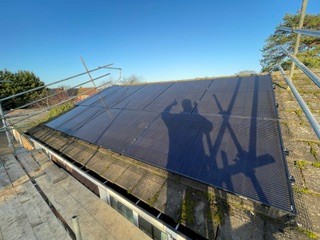
Photo: roof solar array
Overall, we are happy with the system and the installer. Over the 2 full years when we’ve had the system, our solar array has generated about 8% more than forecasted and it has required zero maintenance. I was happy with the installer during the installation and in the follow-up we had to support us with the G98 notification. We haven’t had any other interaction with them since.
We are mostly happy with the heat pump and very happy with the installer.
Pros:
(1) much lower CO2 emissions: estimated ~300kg per year vs 1,450kg from the gas boiler.
(2) the temperature in winter is more constant and managing the heating schedule requires less work than with a gas boiler.
(3) we had the gas connection removed, which saves us ~£100 in standing charges.
Cons:
(1) minimising the running costs for hot water requires some more work than a gas boiler e.g. using as much as possible the off-peak rate or the times of the day with the highest solar PV production. As part of this, we rely on scheduled reheating instead of reheating automatically using the hot water cylinder thermostat. The main downside is that if we consume more hot water than usual (e.g. when we have visitors, or take more showers than usual), we have to remember to manually reheat the water before the next shower/hot bath.
(2) We gained some storage space where we previously had the gas boiler, but we had to sacrifice our small utility room for the hot water cylinder, so overall, we lost some storage space. This is something we didn’t expect until we had the survey.
(3) Some pipes needed re-routing through the hot water cylinder, and in order not to break walls or flooring, they had to run on the corridor wall and therefore became visible.
The installer was excellent. During the survey, we agreed to install the external unit under a window, not expecting that it would be very visible from inside due to the large gap between the unit and the wall. It took some negotiation, but Octopus Energy eventually agreed to schedule another installation 5 months later (project 3) to move the external unit to where it would not be visible, at no extra cost to us.
POST COMPLETION
OUR TOP TIPS
| Energy Consumption | Electricity (kWh) | Gas (kWh) | Wood (kWh) | Total (kWh) |
|---|---|---|---|---|
| Before | 4350 | 8000 | 0 | |
| After | 4200 | 0 | 0 |
| Carbon Footprint | kgCO₂e/m² | kgCO₂e/person |
|---|---|---|
| Before | — | — |
| After | — | — |
* Wood logs estimated at 2,000 kWh/m³. Carbon factors are applied according to the project year. Where a project start or end date is not provided, 2026 is assumed.